June 19, 2026

There is a tendency, whenever a powerful new technology arrives, to skip straight to the most dramatic prediction. For legal AI, the dramatic prediction is that software will replace lawyers outright. It makes for a good headline and a worse forecast. The work lawyers actually do — weighing competing authorities, reading a client's situation, deciding what risk is acceptable and what is not — is not a task you automate away. It is judgement, and judgement is precisely the thing these systems do not have. So the honest question is not whether AI replaces the lawyer. It is how much of the surrounding work the lawyer should ever have to do by hand again.
That reframing is the whole thesis behind Estoppel. We believe the durable future of legal technology is assistive, not autonomous. The most valuable tool is not one that pretends to be a lawyer; it is one that takes the slow, mechanical, energy-draining parts of legal work — the first-pass research, the wading through exhibits, the staring at a blank page before a draft exists — and compresses them from hours into minutes, while leaving every consequential decision exactly where it belongs: with the professional.
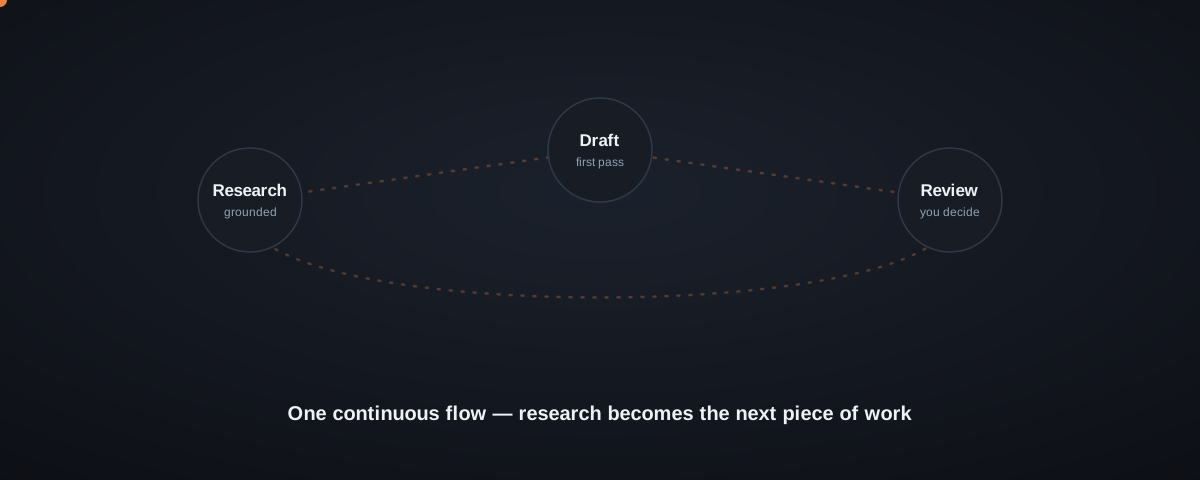
Look closely at what is happening in that exchange, because it captures where the field is going. A practitioner asks a genuine, jurisdiction-specific question — the grounds for bail under Nigerian law — and gets back an answer that reaches for the actual constitutional and statutory provisions rather than a vague, country-agnostic summary. Then, in the same breath, the same workspace turns that research into a draft application addressed to the right court. There is no copy-pasting between a research tool and a word processor, no losing the thread between what the law says and the document that has to say it. The intelligence stays in one continuous flow.
That continuity is, we think, the quiet revolution. Not a smarter answer to a single question, but a workspace where the answer becomes the next piece of work. The second thing the future demands is honesty about jurisdiction. Law is not one thing; it is thousands of overlapping systems, and an AI that flattens them into a generic average is worse than useless — it is confidently wrong in a way that costs people. Good legal technology has to know that it does not know everything about every jurisdiction, has to lean on the materials in front of it, and has to be candid about the limits of its reach.
And the third thing — the one we are least willing to compromise on — is trust. The technology that wins in law will not be the flashiest; it will be the one practitioners can rely on without being burned. That means anti-fabrication by design, citations a professional can verify rather than take on faith, and a constant, unembarrassed reminder that the output is a draft to be checked, not a verdict to be trusted. A tool that is brilliant nine times and invents a case the tenth is not a tool a serious lawyer can use. Reliability is not a feature you add at the end. It is the foundation you build everything else on top of.
Put those three together — assistive rather than autonomous, jurisdiction-aware rather than generic, trustworthy rather than merely impressive — and you have a fairly precise picture of where we think legal technology is going. It is a future where the lawyer is faster, sharper and less buried in mechanical work, and still, unmistakably, the one in charge. Estoppel is our attempt to build that future a little earlier than it would have arrived on its own.