
June 19, 2026

There is a comfortable way to talk about responsible AI, and an honest one. The comfortable way is to add a disclaimer to the bottom of the screen and move on. The honest way is to admit that, in a field like law, responsibility cannot be a footnote — it has to be a design philosophy that shapes the product from the first screen to the last exported file. A legal tool that is brilliant nine times and quietly invents a case the tenth is not a useful tool with a small flaw. It is an unusable tool, because the one failure can undo all nine successes and put someone's name on the line. We built Estoppel around that uncomfortable truth.
The first commitment is anti-fabrication. The failure mode everyone now knows about — an AI confidently citing a case that does not exist — is not a rare edge case to be embarrassed about later; it is the central risk of using language models in law, and it has to be designed against rather than apologised for. That means Estoppel is built to distinguish between what it can support and what it is merely guessing at, to lean on the actual materials in front of it, and to be candid about uncertainty instead of papering over it with confident prose.
Notice where that reminder lives. It is not hidden in a terms-of-service page nobody reads; it sits right under the place where you type, every single time: Estoppel can make mistakes, verify every citation and authority before you rely on it, this is not legal advice. We are sometimes asked whether putting the limitation front and centre undercuts the product. We think the opposite is true. A tool that is honest about being a draft-maker rather than a decision-maker is a tool a serious professional can actually trust, precisely because it is not pretending to be something it is not.
The second commitment is keeping the human in the loop by design, not by hope. Estoppel produces first drafts, research starting points and structured arguments — and it is built on the assumption that a qualified person will review, correct and, ultimately, own and sign the final product. The system gives the professional the controls — a default jurisdiction, the depth of answers, the citation style — and then defers to them. It never closes the loop on its own.
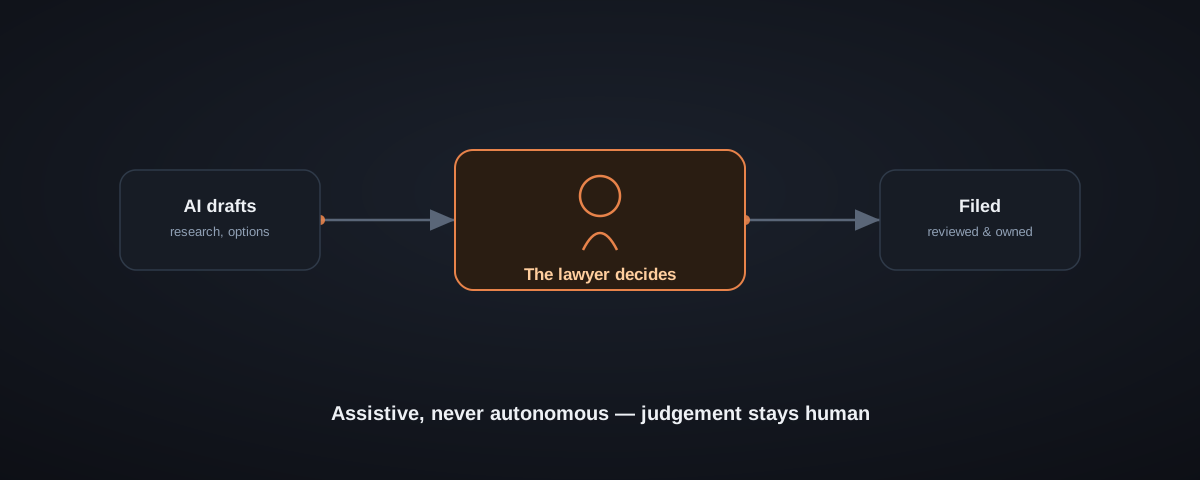
The workspace is shaped to make review natural: research and drafting sit together so you can trace a claim back to what it rests on, citations are surfaced so they can be checked, and nothing is presented as a finished legal conclusion. The lawyer is not a rubber stamp at the end of an automated pipeline. The lawyer is the point of the pipeline.
There is a third, quieter commitment, and it is about respect for the people on the other side of the screen. Legal matters carry some of the most sensitive information a person ever shares. Responsible legal AI has to treat that material with care — to be clear about how content is processed, to avoid asking users to hand over more than they are authorised to share, and to never quietly turn a client's confidential matter into training fuel. Trust, in this domain, is not won with a clever feature. It is won by being predictable, transparent and restrained, over and over, until reliability becomes the thing people expect from you.
We do not think any of this makes Estoppel less ambitious. We think it makes it more so. It is easy to build an AI tool that is impressive in a controlled demo. It is much harder to build one a practitioner can lean on during a real matter, on a real deadline, with real consequences — and that is the only kind worth building. Keeping the lawyer in control is not a constraint we reluctantly accept. It is the entire point.